

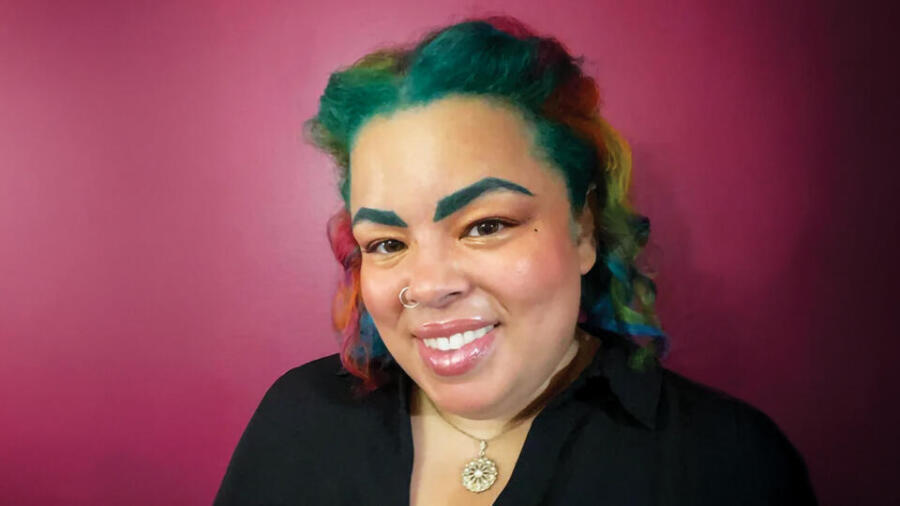
Before ever stepping into a courtroom, Valentine already understood the power of presence. After all, they’ve shimmied on stages as a burlesque performer, consulted behind the scenes for creative businesses and moved through the adult industry not just as an advocate, but as a participant.
Today, as deputy executive director of the Free Speech Coalition, Valentine’s work bridges legal strategy, protecting members’ access to financial services and working to shatter stigma through visibility.
Because of the stigma that’s thrust upon us, we have to fight harder to earn the credibility that others are afforded automatically.
It’s a job that demands fluency in two very different languages: the coded language of institutions, and the lived reality of the communities those institutions often fail to understand or acknowledge. Fortunately, Valentine speaks both.
“I’ve always felt a connection with, and had a soft spot for, the adult industry,” they explain. “I’ve had a fervor about protecting rights within the industry and in the broader landscape of sex work as well.”
Valentine’s roots in sex work go back to around 2007, when they began performing burlesque and connected with circles of artists and sex workers who became their community.
“My undergraduate degree is in musical theater performance,” they share. “After years of performance work, I started doing business consulting because I had a knack for the business end of things. From there, I ended up getting a master’s in arts management, which is kind of like an MBA that’s geared toward creative industries. That’s where I discovered I was interested in the law.”
‘Exactly what I had been waiting for’
Valentine enrolled in law school in 2021, not to reinvent themself but to double down on their commitment to advocacy.
“I was very out about sex work because it was a big part of why I went to law school to begin with,” they affirm. “As an older student, I wasn’t going to get pressured into manufacturing some version of myself that isn’t true, just so I can get a job that I hate.”
That honesty resonated with the right people. At a conference, Valentine met the late First Amendment attorney and FSC executive board member Reed Lee, who became a mentor.
“Reed took an interest in me and took my goals seriously, even though they seemed kind of weird and far-fetched,” Valentine recalls. “I wanted to help sex workers and artistic communities in ways that weren’t necessarily on a clear track, like tax law would be. Reed was wonderful. He got me involved with the First Amendment Lawyers Association and connected me with the Free Speech Coalition.”
Valentine began attending FSC legislative and legal committee meetings. As it turned out, their timing couldn’t have been better. In the summer of 2024, while prepping for the bar exam and facing a competitive job market, they spotted a LinkedIn post by FSC Executive Director Alison Boden, about a new deputy position.
“I didn’t know it, but this was exactly what I had been waiting for,” Valentine says. “I reached out to Alison and said, ‘I want you to know I’m genuinely interested in this. This is the perfect thing.’ It just felt like kismet.”
By fall, Valentine was on staff.
Bridging Worlds
During their first year with FSC, Valentine’s work has been dominated by one massive project: building a credit union designed to serve the adult industry.
“It’s a lot of meetings and paperwork, but also a lot of outreach and education,” they note. “Like explaining what a credit union is to people who aren’t credit union people, and explaining what the adult industry is to people who aren’t from that world. My job is to bridge those worlds a little bit.”
In practice, that has meant advocacy on multiple fronts: with financial institutions, policymakers and others who often misunderstand the realities of the adult industry.
“A lot of people in the industry experience issues with accounts, loans, mortgages — even when they’re financially secure,” Valentine observes. “You might be making a lot of money, but it comes in sporadically, and that sets off flags when you’re applying for something. Or your account gets flagged as fraudulent just because you got six small payments in a row from a platform.”
These barriers, Valentine stresses, are ultimately about stigma.
“We have more in common with the rest of the world than we don’t,” they point out. “But because of the stigma that’s thrust upon us, we have to fight harder to earn the credibility that others are accorded automatically.”
Relatability and Intersectionality
One of Valentine’s strongest assets in their advocacy role is their personal lived experience. As both a performer and a lawyer, they bridge the gap between policy and practice.
“My background in the arts and in adult performance is a huge part of why I can connect with people in the industry,” they explain. “People don’t feel like they’re talking to an outsider. I understand what they’re talking about when they refer to a client situation because I’ve been there. That gives me an advantage in getting to know people and building trust.”
Meanwhile, the “legitimacy” that comes with Valentine’s legal advocacy helps them expand the horizons of policymakers and members of the public, who might otherwise default to stereotypes.
“I think people don’t see our humanity unless they have a direct connection to the industry,” says Valentine. “They need to see us as what we are: unique people with our own experiences, perspectives, goals and dreams.
“There’s so much focus spent on scrutinizing sex workers, while other professions' issues — like the high rate of addiction among lawyers — are not used as reasons to strip rights from an entire group,” they add. “There’s a lot of cognitive dissonance, on both the left and right.”
Valentine’s identity also shapes their approach to leadership and advocacy, from financial inclusion to policy fights to how FSC shows up for its members.
“I’m Black, I’m queer, I’m nonbinary and I’m disabled,” they share. “There are so many people in the industry with whom I share some part of my identity. So I see the ways these issues are compounded for people who are marginalized in one way or another. That’s a huge part of what I bring to my job and how I show up for work.”
Self-Care and Balance
The work isn’t easy. Advocacy can be emotionally demanding, and Valentine admits they’re still learning how to carve out enough space for rest.
“I do a lot of advocacy work outside of FSC as well, like with Decrim Illinois, so I could be better at taking breaks,” they admit. “But I’ve been going to a lot of movies lately. Sometimes I go with a partner, but I also like going by myself. Then you don’t have to share your popcorn!”
They also relax with crossword puzzles, karaoke, hanging out with their cats, and arts events like live music, museums and burlesque. Performing, in particular, remains an important outlet.
“It’s wonderful to have something to pour energy into that is just for me and the people who care about my art,” they say with a bright smile.
A Vision of Progress
As Valentine moves into their second year with FSC, their focus remains on the credit union project, intellectual property initiatives and helping steer litigation strategy from behind the scenes.
“I never want to be the person tap dancing in front of the court,” they confide. “But I love helping where I can with strategy and research. A lot of the transactional work I do is about avoiding litigation later on.”
For Valentine, the work is both personal and deeply collective. They speak often of their gratitude for their fellow FSC team members — Alison Boden, Jeffrey Douglas and others — who have built a supportive environment.
“I love my co-workers,” Valentine gushes. “It’s the healthiest work environment I’ve ever been in, by far. I feel fully seen when I show up to work, and I feel like I can come to them with anything. I know how rare that is, and I feel lucky as hell.
“We’ve had losses and we’ve had wins, but we’re still here and still pushing,” they declare. “The goal is the same as when this all started. The practical, focused strategy is necessary, but the bigger fight is turning the tide of ‘They’re all like this,’ or ‘They’re all like that.’”
That combination of hard strategy and lived empathy defines Valentine’s leadership. They are a lawyer and an advocate, but also a performer, a community member — and a human being who refuses to be reduced to a single dimension, or allow the same to happen to the industry stakeholders for whom they are fighting.
“We’re just as varied and diverse as any other group of people,” they conclude. “That can be hard to make people understand. But it’s also where progress really lives.”